

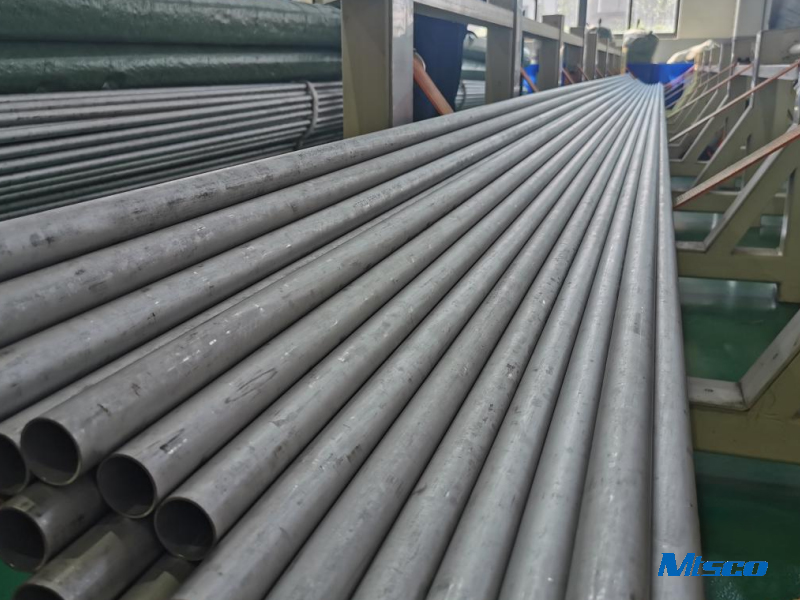
PED / ISO certifié ASTM A622 Nickel Alloy C22 / UNS N06022 Pipe pour pétrochimie
PED / ISO certifié ASTM A622 Nickel Alloy C22 / UNS N06022 Pipe pour pétrochimie
1. Grade : UNS N06022, N06625 ,N06600 , N06601 , N07718 , N10276 , N08800 , N08825 ,N04400 ; etc
2 . OD ( Outer Diameter ) : 6.35mm to 114.3mm
3 . WT ( Wall Thickness ) : 1.65mm to 20mm
4 . Length : As customer’s requirement
5 . Standard : ASTM B163; ASTM B167; ASTM B444; ASTM B622 etc
6 . Technology : Cold Drawn / Cold Rolled
Nickel Alloy C22 Chemical composition
% | Ni | Cr | Mo | Fe | W | Co | C | Mn | Si | P | S | V |
| équilibre | 20 | 12.5 | 2 | 2.5 |
|
|
|
|
|
|
|
maximum | 22.5 | 14.5 | 6 | 3.5 | 2.5 | 0.015 | 0.5 | 0.08 | 0.02 | 0.02 | 0.35 |
Caractéristiques: Nickel Alloy C-22 is a versatile Ni-Cr-Mo-W alloy with better comprehensive corrosion resistance performance than other Ni-Cr-Mo alloys, including Alloy C-276, Alloy C-4 and Alloy 625. Alloy C-22 has outstanding resistance to pitting, crevice corrosion and stress corrosion cracking. It has excellent resistance to oxidizing aqueous media including wet chlorine and mixtures containing nitric acid or oxidizing acids with chloride ions. It also offers optimum resistance to environments where reducing and oxidizing conditions are encountered in process streams. So it can be used where “upset” conditions are likely to occur or in multi-purpose plants.
 |  |
| Demande | a) Échangeur de chaleur |
| b) condenseur | |
| c) Industrie du transport maritime | |
| d) Machinerie de précision | |
| e) Industrie de la structure mécanique | |
| f) Thermocouple et câble, etc. |
Fabrication de Hastelloy C22:
Bien que la ténacité soit suffisante pour se développer par le travail au froid, un recuit intermédiaire peut être nécessaire en raison de l'efficacité du travail. Le forgeage doit être effectué entre 1750 - 2050 ° F, suivi d'un refroidissement rapide. Le recuit peut être effectué dans la plage de températures de 2020 - 2150 ° F, suivi d'une extinction rapide. Le refroidissement accéléré évite la formation de phases nocives entre 1400 - 1800 ° F. Le soudage peut être effectué par un arc à gaz en tungstène, un arc à gaz en métal et des processus d'arc métallique protégés.
